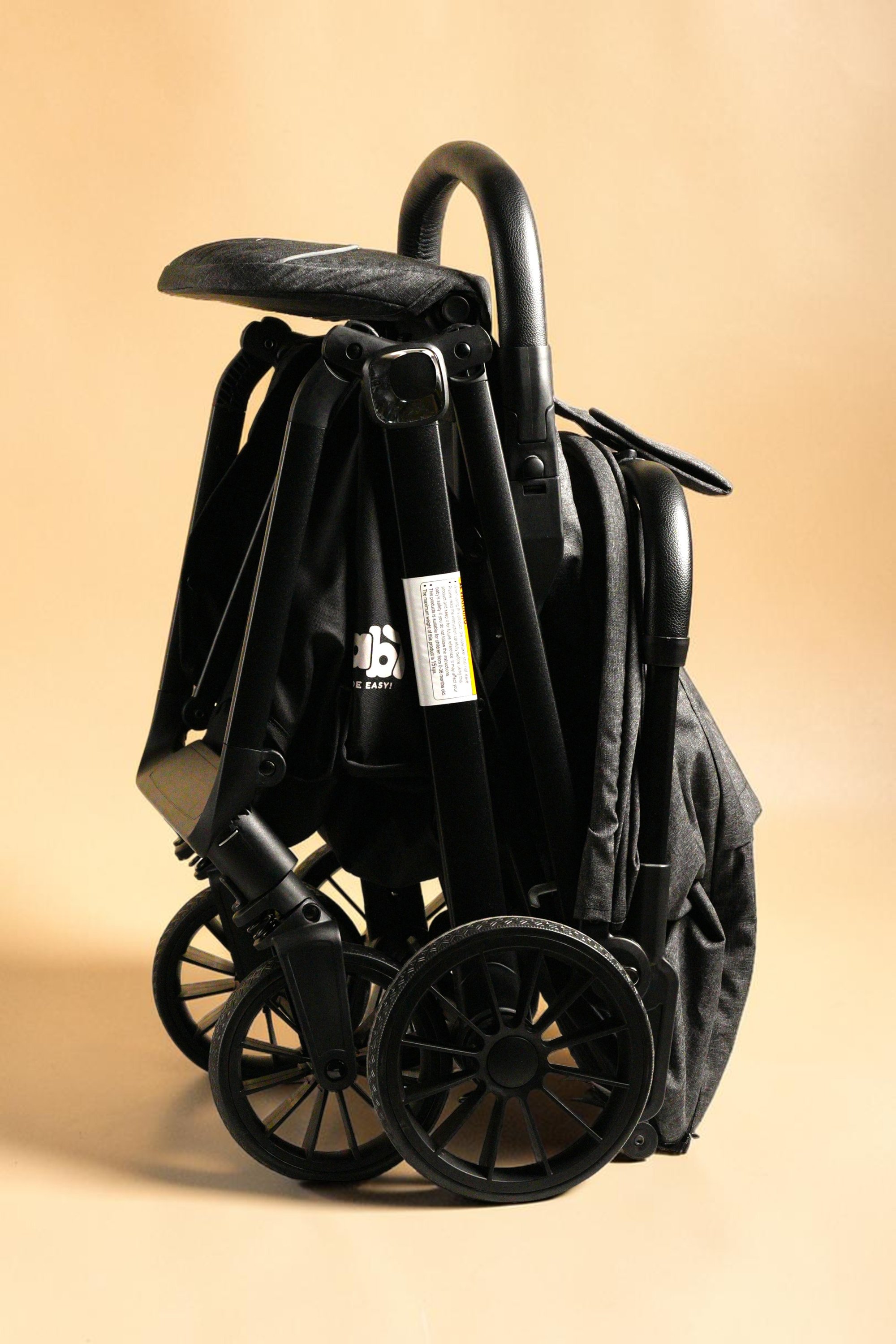
Jogging strollers look serious. Big air-filled tyres, three-wheel stability, sporty fabric, and a parent running gracefully alongside — that’s the marketing image. The Indian reality is messier: most cities don’t have continuous joggable pavements, the tyres puncture on construction debris, and dedicated park tracks are limited. We tested two joggers across Delhi parks and broken Mumbai pavements to figure out who should actually buy one.
Skip a jogger as your only stroller. Buy one only if (a) you have a dedicated park or jogging-track within 1–2 km, (b) you’ll use it 3+ times a week, and (c) you have storage for the bulk. For 99% of Indian parents, a 4-wheel daily stroller is the right primary stroller.
What Makes a Stroller a “Jogger”
- 3-wheel layout — one front, two rear. Better straight-line tracking at running speed.
- Air-filled tyres (12”–16”) — cushion impact at speed.
- Wrist strap — safety tether so the stroller doesn’t roll away if you stumble.
- Lockable swivel front wheel — locked straight for running, swivel-mode for walking.
- Hand brake on the handle — for slowing on downhills.
If a stroller is missing the wrist strap, lockable front wheel, or hand brake, it is a fashion 3-wheel stroller, not a jogger.
Where Joggers Work in India
Cities and locations where a jogger genuinely works:
- Delhi — Lodhi Garden, Sanjay Van, Nehru Park.
- Mumbai — Joggers’ Park, Marine Drive promenade, BKC ground.
- Bengaluru — Cubbon Park, Lalbagh, Hebbal lake loop.
- Hyderabad — KBR Park, Hussain Sagar walkway.
- Chennai — Marina, Theosophical Society.
- Gated colonies / DDA parks with internal pavement loops.
Outside dedicated park infrastructure, jogging-stroller use is impractical — pavements end, traffic, debris, dust.
Age and Safety Considerations
Jogging exposes baby to vibration. Spinal and neck development must be advanced enough to absorb it.
- Under 6 months: Do not jog. Walk only.
- 6–9 months: Walk pace only; jogging not recommended.
- 9 months and older: Light jogging in a true jogger is safe.
- Speed cap: most jogger manufacturers cap recommended jogging speed at 8–10 km/h.
Realistic Jogger Picks in India
- R for Rabbit Hokey Pokey — ₹8,499. Entry-level. Adequate for park use, not real running.
- Babyhug Cruise All-Terrain — ₹11,200. Better wheels, ASTM F833.
- Tiffy & Toffee Crusader — ₹14,500. Largest air tyres in Indian-made joggers.
- BOB Revolution Flex 3.0 (imported) — ₹55,000. Global gold standard.
Why Joggers Fail As Daily Strollers
- 11–13 kg — too heavy for IndiGo cabin or Indian apartment lifts.
- Folded size is enormous — doesn’t fit standard car boots.
- Air tyres puncture on broken Indian footpaths — you’ll re-pump or repair frequently.
- Locked front wheel makes mall and supermarket navigation clumsy.
A Better Alternative for Fitness Parents
If you want to exercise with baby, a baby carrier (Ergobaby, Tula, BabyBjorn) plus a brisk walk works for most parents and routes. For higher-impact running, leave baby home and run solo — high-impact running is not recommended with baby in carrier or stroller before 9 months anyway.
For everyday outings, a daily-use lightweight stroller like the Hababy Ultra handles park walks, malls, supermarkets, and travel from a single 7.8 kg package. For most Indian parents, that combination beats a jogger plus a second “daily” stroller.
FAQ
Are jogging strollers good for India?
Only if you have a dedicated jogging-track within 1–2 km and will use it 3+ times a week.
What age can a baby use a jogging stroller?
9 months and up for actual jogging.
Are 3-wheel strollers safer than 4-wheel?
Neither universally; 3-wheel is better at speed, 4-wheel better at slow walking.
Can I use a jogger as a daily stroller?
Possible, but most parents end up regretting the bulk.
Best jogging stroller in India?
BOB Revolution (imported) for serious runners; Babyhug Cruise for park use.